Nickel Alloy Rene N5
General Technical Characteristics
Material Type: Second-generation single-crystal (SX) heat-resistant nickel-base superalloy.
Grade: Rene N5 (René N5).
Designation: Rene N5, GE B50TF248, Rene N500 (rhenium-free modification for less stressed turbine stages).
Standards / Specifications: GE B50TF248, AMS (aerospace and power generation turbomachinery industry specifications).
Alloy Base: Nickel (Ni).
Alloying System: Ni-Co-Cr-Ta-Al-W-Re-Mo-Hf-Y.
Primary Manufacturing Method: Vacuum Induction Melting (VIM) followed by precision vacuum single-crystal investment casting.
Strengthening Mechanism: Precipitation hardening (approx. 68–70% $\gamma’$-phase) and solid-solution strengthening with rhenium, tungsten, and tantalum.
Key Properties: Ultimate creep-rupture strength (up to 1100–1130 °C), complete elimination of grain boundaries, and outstanding resistance to oxidation and protective coating spallation.
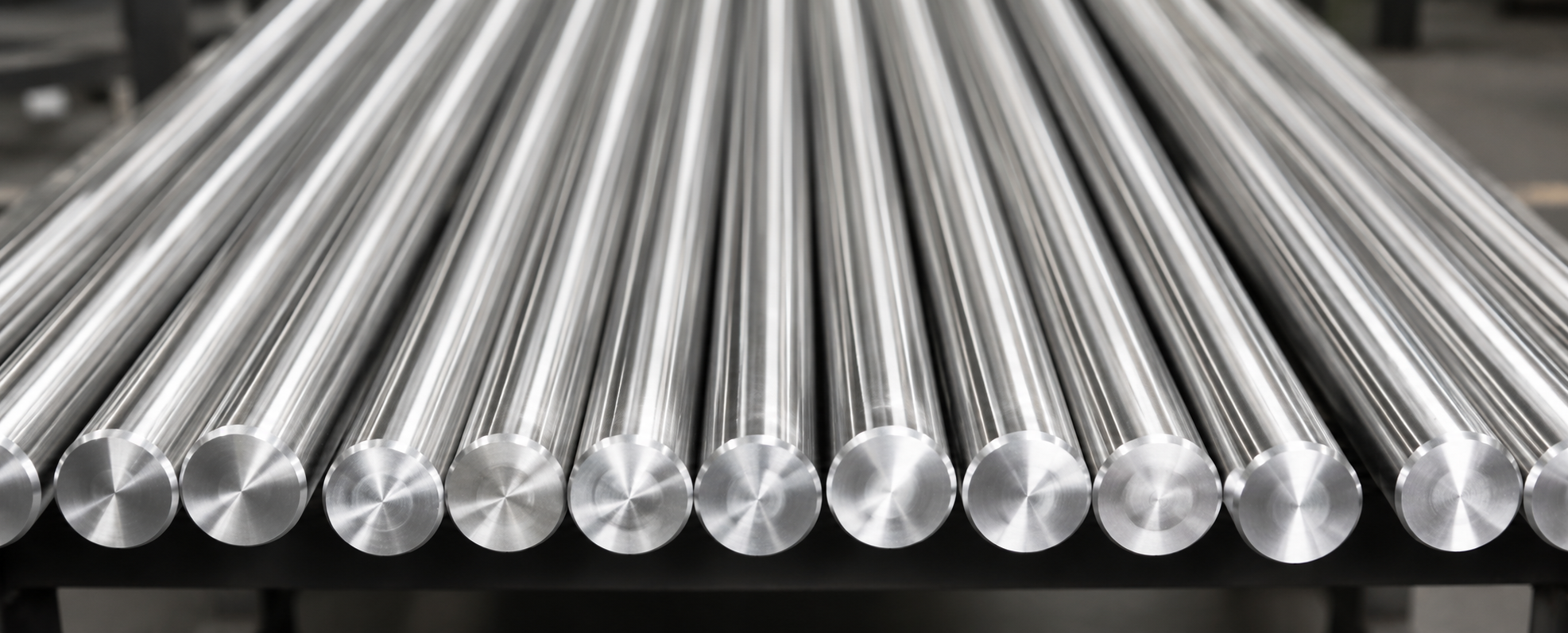
Supply Forms: High-purity cast remelt ingots (master alloy), single-crystal castings, and blanks.
Chemical Composition
| Element | Content, % | Element | Content, % |
| Nickel (Ni) | Balance | Rhenium (Re) | 2.80 – 3.20 |
| Cobalt (Co) | 7.00 – 8.00 | Molybdenum (Mo) | 1.30 – 1.70 |
| Chromium (Cr) | 6.80 – 7.30 | Hafnium (Hf) | 0.12 – 0.20 |
| Tantalum (Ta) | 6.30 – 6.80 | Carbon (C) | 0.04 – 0.06 |
| Aluminum (Al) | 6.00 – 6.40 | Boron (B) | 0.003 – 0.006 |
| Tungsten (W) | 4.80 – 5.20 | Yttrium (Y) | 0.005 – 0.020 (micro-addition) |
| Titanium (Ti) | max 0.05 | Iron (Fe) / Silicon (Si) | max 0.20 / max 0.05 |
Mechanical and Performance Properties
ultra-high stress-rupture strength and creep resistance due to its single-crystal structure and the rhenium effect;
outstanding resistance to cyclic high-temperature oxidation and alumina ($\text{Al}_2\text{O}_3$) scale spallation via yttrium micro-alloying;
maximum resistance to thermal fatigue and thermal shock owing to the low elastic modulus in the
<001>crystallographic orientation;high phase stability without brittle topologically close-packed (TCP) phase precipitation over extended service lives;
superior compatibility with aluminide, platinum-aluminide, and advanced thermal barrier coatings (TBC).
Density: approx. 8.63 g/cm³.
Melting Range: approx. 1320 – 1390 °C.
<001> crystallographic orientation accuracy and multi-stage vacuum heat treatment regimes, and are therefore governed by the documentation for a specific batch.Applications
single-crystal high-pressure turbine (HPT) rotor blades for modern commercial and military aircraft engines (GE90, GEnx, CFM56, F110 families, etc.);
cooled first-stage turbine nozzle guide vanes and stator assemblies with intricate internal cooling passages;
high-temperature blades for heavy-duty stationary H- and J-class industrial gas turbine units;
hot-section flowpath components for marine and aeroderivative gas turbine engines;
critically loaded elements in aerospace turbopump assemblies.
Key Features of Rene N5
rhenium alloying (~3%), radically retarding diffusion-controlled creep at ultra-high temperatures;
yttrium (Y) micro-alloying, delivering exceptional cyclic oxidation resistance without requiring ultra-expensive charge desulfurization;
near-zero titanium content (less than 0.05%), enhancing the stability of the protective alumina scale;
balanced alloying with tantalum (~6.5%) and tungsten (~5%), preventing casting defects (freckle chains) during single-crystal solidification;
proven reliability across tens of thousands of operating hours in the world’s most demanding gas turbine engines.