Nickel Alloy K403 / ZhS6K
General Technical Characteristics
Material Type: Cast precipitation-hardenable heat-resistant nickel-base superalloy.
Grade: K403 / ZhS6K (ЖС6К).
Designation: K403 (former designation K3, ISC H84030), ZhS6K (ЖС6К, ЖС6-К).
Standards / Specifications: GB/T 14992, HB (for K403); TU / OST 1 90126-85 / VIAM (for ZhS6K).
Alloy Base: Nickel (Ni).
Alloying System: Ni-Cr-Al-W-Co-Mo-Ti-C-B.
Primary Manufacturing Method: Vacuum Induction Melting (VIM) followed by precision vacuum investment casting (equiaxed or directionally solidified).
Strengthening Mechanism: Precipitation hardening (approx. 55–60% γ’-phase), matrix solid-solution strengthening (W, Mo, Co), and grain-boundary carbide/boride strengthening.
Key Properties: High creep-rupture strength and creep resistance at temperatures up to 900–950 °C (short-term up to 1000 °C), and high fatigue strength.
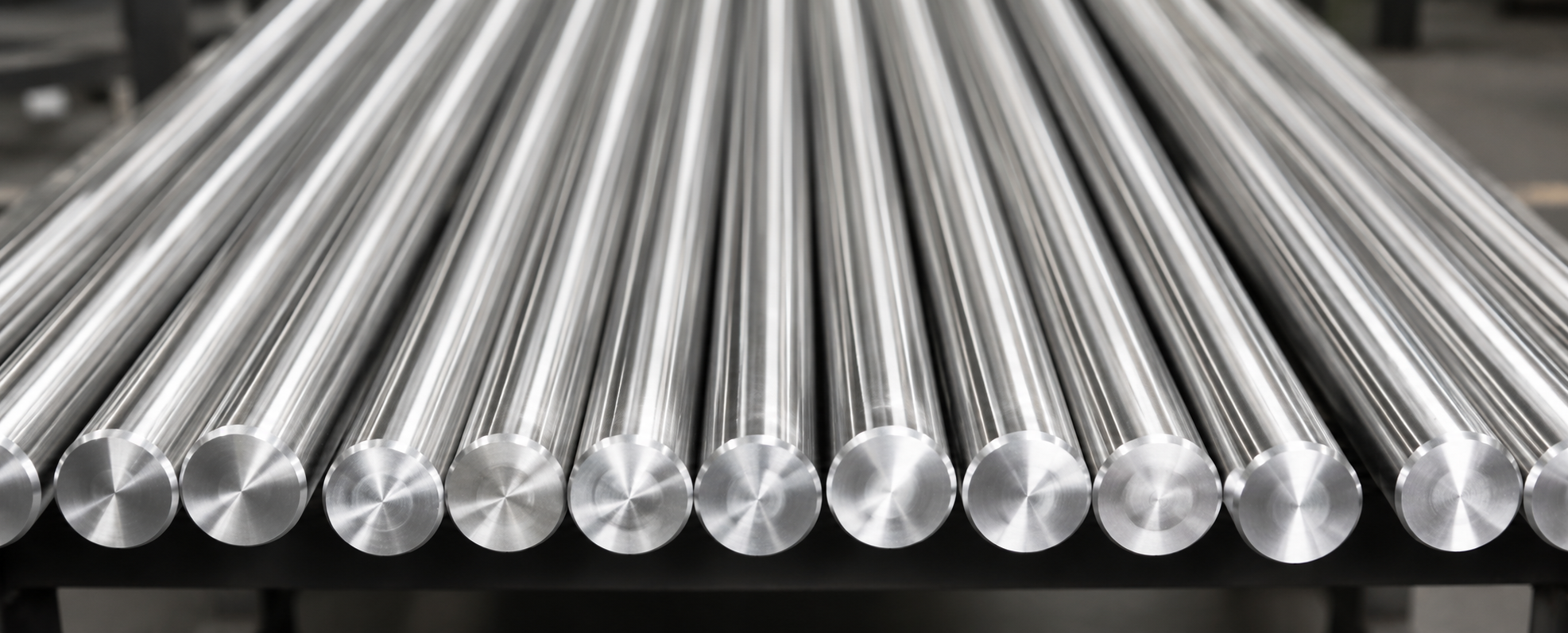
Supply Forms: Cast remelt bars and ingots (master alloy), shaped castings, and cast blanks.
Chemical Composition
| Element | K403 (GB/T 14992), % | ZhS6K (OST 1 90126-85), % |
| Nickel (Ni) | Balance | Balance |
| Chromium (Cr) | 10.00 – 12.00 | 10.50 – 12.50 |
| Aluminum (Al) | 5.30 – 5.90 | 5.00 – 6.00 |
| Tungsten (W) | 4.80 – 5.50 | 4.50 – 5.50 |
| Cobalt (Co) | 4.50 – 5.50 | 4.00 – 5.50 |
| Molybdenum (Mo) | 3.80 – 4.50 | 3.50 – 4.50 |
| Titanium (Ti) | 2.30 – 2.90 | 2.50 – 3.20 |
| Carbon (C) | 0.11 – 0.18 | 0.13 – 0.20 |
| Boron (B) | 0.012 – 0.022 | max 0.020 |
| Zirconium (Zr) | 0.03 – 0.08 | max 0.04 (nominal) |
| Iron (Fe) | max 2.00 | max 2.00 |
| Manganese (Mn) / Silicon (Si) | max 0.50 / max 0.50 | max 0.40 / max 0.40 |
Mechanical and Performance Properties
high heat resistance, stress-rupture strength, and creep resistance within the 800–950 °C temperature range;
enhanced resistance to high-cycle and thermal fatigue due to a balanced aluminum-to-titanium ratio;
good resistance to hot gas corrosion when protected by aluminide or chromized-aluminide diffusion coatings;
microstructural phase stability during prolonged thermal exposures without susceptibility to brittle topologically close-packed (TCP) phase precipitation when charge purity is maintained;
high molten fluidity during vacuum casting of thin-walled turbine airfoil profiles.
Density: approx. 8.15 – 8.25 g/cm³.
Melting Range: approx. 1245 – 1335 °C.
Applications
cooled and uncooled high-pressure and low-pressure turbine rotor blades for aircraft gas turbine engines;
turbine nozzle guide vanes, stator vane segments, and stator shroud rings;
integrally cast rotors and turbine wheels (blisks) for small gas turbine engines, auxiliary power units (APUs), and turbochargers;
hot-section components for marine and industrial gas turbine units.
Key Features of K403 / ZhS6K
high specific creep-rupture strength (strength-to-density ratio), reducing centrifugal loads on turbine disks;
excellent mold-filling capability for thin-walled castings with complex aerodynamic geometries;
cost-effectiveness achieved by omitting expensive rhenium and tantalum additions;
full metallurgical class interchangeability between K403 and ZhS6K upon technical specification alignment;
decades of proven operational reliability across serial aircraft and industrial gas turbines.